

How to choose carp boilies for your water and fish
The brightest, strongest-smelling boilie isn’t automatically right for your water. Boilies are round baits made from ingredients such as eggs and flour or semolina, then cooked to form a firm outer skin. This helps them stay on a hair rig and resist being picked apart by small fish. Knowing how to choose carp boilies means matching the ingredients, size and presentation to the carp, the water and the fishing pressure.
It’s easy to focus on a flavour that’s caught elsewhere, but the useful choice is the one that fits how and where you’re fishing. This guide explains what goes into a boilie and how its nutritional profile can matter, then covers water conditions, carp stock, fishing pressure, flavour, colour, buoyancy and size. You’ll also learn how to weigh up shelf life, frozen bait and soluble bait, so you can choose for the session rather than by appearance alone.
Key Takeaways
- Start with the water, carp stock and fishing pressure, then choose a baiting approach that suits the conditions rather than relying on a favourite flavour alone.
- Match boilie size, colour and buoyancy to your presentation and the fish’s feeding behaviour; small changes can make a rig sit and stand out differently.
- Look beyond attraction and consider the ingredients and nutritional value when selecting bait for repeated feeding.
- Choose shelf-life, frozen or soluble boilies according to how you store bait and how quickly you want it to break down in the water.
1. Matching bait to water, stock, and fishing pressure
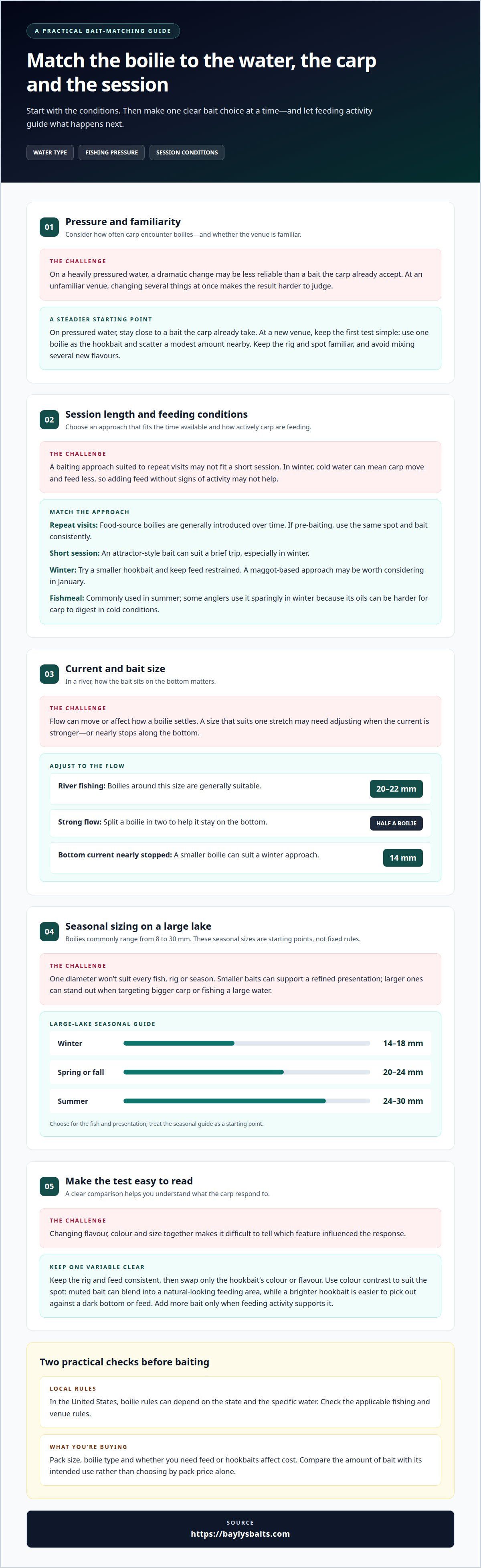
Start with the water, not the flavour. Note whether you’re fishing a small, heavily pressured pond, a large lake or a flowing river. Then consider what the carp usually eat and how often they encounter boilies. On a pressured water, a bait they already accept can be a steadier starting point than a dramatic change. At an unfamiliar venue, keep the first test simple: use one boilie as the hookbait and scatter a modest amount nearby.
Match your feeding approach to the session. Food-source boilies are generally introduced over time, making them a sensible fit for repeat visits and planned pre-baiting. An attractor-style bait can suit a short session, especially in winter, when cold water can mean carp move and feed less. If you pre-bait, use the same spot and bait consistently, then look for signs of feeding before adding more.
For winter fishing, try a smaller hookbait and keep the feed restrained. A maggot-based approach can also be worth considering in January. Fishmeal boilies are commonly used in summer, while some anglers use them sparingly in winter because their oils can be harder for carp to digest in cold conditions. Let the water and the carp’s response guide your next move.
River current changes how a bait sits. Boilies around 20-22 millimeters are generally suitable for river fishing, but a strong flow may call for splitting one in two to help it stay on the bottom. Where the bottom current nearly stops, a smaller boilie, such as 14 millimeters, can suit a winter approach.
To test a new boilie, keep the rig and spot familiar. Introduce a small amount beside the hookbait and avoid mixing several new flavours at once. That makes it easier to judge whether the bait is being picked up. Add more only when feeding activity supports it.
In the United States, don’t assume boilies are permitted or prohibited everywhere. Rules can depend on the state and the specific water, so read the applicable fishing and venue rules before baiting.
There’s no single useful cost for every setup. Pack size, boilie type and whether you’re buying feed or hookbaits all affect what you pay. Compare the amount of bait with its intended use, rather than choosing by pack price alone.
2. Boilie flavors, colors, buoyancies, shapes, and sizes
Size changes how a hookbait looks and how easily a carp can take it. Boilies commonly range from 8 to 30 millimeters, so match the diameter to the fish and your rig. For a refined presentation, smaller baits can be useful; larger baits stand out when you’re targeting bigger carp or fishing a large water. On a large lake, a practical seasonal guide is 14-18 millimeters in winter, 20-24 millimeters in spring or fall, and 24-30 millimeters in summer. Treat these as starting points, not fixed rules.
Flavour matters, but a familiar or popular option won’t suit every session. Strawberry and Tutti-Frutti are familiar fruit flavours, while fishmeal offers a different profile. If carp already feed confidently on a particular bait in your water, staying close to that choice may make more sense than changing flavour, colour and size together. Change one feature at a time to get a clearer read on what the fish respond to.
Colour affects the bait’s visual contrast against the lakebed. A muted boilie can blend into a natural-looking feeding area, while a brighter hookbait is easier to pick out against a dark bottom or feed. Choose the contrast that suits the spot, rather than treating bright colour as an automatic advantage.
Buoyancy controls how the bait sits beside the hook. A sinking boilie rests on the bottom, while a pop-up lifts the hookbait; a wafter balances the rig so the bait sits lightly. Check the finished presentation in the margins before casting, especially if you’ve changed hookbait size. Round boilies are the familiar choice, while a different shape can change how the hookbait settles among the feed.
For a simple test, keep the rig and feed consistent and swap only the hookbait’s colour or flavour. If you’re narrowing down options, compare carp boilie ranges by their flavour profile and intended presentation, then choose one clear change for your next cast.
3. Boilie nutritional value and fish health
A boilie does more than carry flavour to the hook. Its ingredients determine whether it offers a food profile suited to repeated feeding. Eggs bind a mix, while flour or semolina provides its base. Fishmeal, seeds and other ingredients create different nutritional profiles, so judge the recipe by its contents, not just its smell or colour.
For a longer campaign, consistency matters. If you’re introducing boilies as a regular food source, use the same recipe and feeding spot, then observe how carp respond over successive visits. A food bait used repeatedly should make sense as part of the overall feed, rather than being chosen solely for strong instant attraction. Keep the amount tied to observed activity.
Consider how the bait is made, as well as what goes into it. Cooking can affect a bait’s final qualities, and steaming is one method used in bait production. For an angler, the practical point is to consider processing alongside the ingredient list. No single cooking method tells you everything about a boilie’s value.
Amino acids and micronutrients are terms worth understanding on a bait description. They refer to nutritional components, but their presence alone doesn’t show how a complete recipe performs. Look at the whole formulation: a list of attractive ingredients still needs to make sense as a food bait, particularly if you plan to feed repeatedly.
Keep fish welfare in mind at the bank. Introduce a new food-source boilie gradually, avoid piling bait onto a spot without signs of feeding, and remove unused bait where practical. If carp aren’t visiting a pre-baited area, adding more feed won’t improve the recipe’s nutritional value. Review the location, timing and amount before changing bait. That’s more useful than judging a boilie by appearance alone.
4. What is the difference between shelf-life, frozen, and soluble boilies?
The labels describe how boilies are preserved or behave in water, so think about storage and session length first. Shelf-life boilies are made to be stored without freezing, making them practical if you want bait ready in your tackle bag. Their formulation differs from fresh baits, so don’t assume every shelf-life recipe matches a frozen version ingredient for ingredient.
Frozen boilies are kept frozen until use, which suits anglers who want freshly rolled bait without drying it for storage. Freshly rolled boilies can also be kept longer by air-drying them or freezing them in vacuum bags. Once you take frozen bait to the bank, bring only what you expect to use and keep the rest frozen at home.
Soluble describes how a bait breaks down in water, not how it’s stored. A soluble boilie releases material as its outer layer softens, while a harder bait can stay intact longer. Water temperature, flow, bait size and the mix all affect how quickly it breaks down, so test one beside the bank before relying on it for a long cast.
Choose the bait that matches the job. For a short session, convenient shelf-life bait may be easier to carry and use. For a planned campaign, frozen bait can suit anglers who prefer freshly rolled bait and can manage frozen storage. Soluble options can work when you want the hookbait to release attraction, but they may need replacing sooner. The label alone doesn’t tell you how long a bait will last on your rig.
Keep a simple record: note the bait type, storage, water conditions and time in the water. Compare how a shelf-life and a frozen bait soften in the same margin spot, then choose the one that fits your casting time and feeding plan. If you’re ready to select bait for your next session, browse the boilie options and match the format to how you fish.
Baylys Baits
Once you’ve weighed up your water, target fish and session style, Baylys Baits offers four boilie ranges to consider: Apex, Gods Gift, Pineapple Express and Secret Sauce. Each gives you a different starting point for matching your bait to your approach, whether you’re planning regular feeding or choosing a hookbait for a shorter trip.
Use the decisions in this guide to narrow down what matters most: flavour profile, presentation, and whether you need bait for feeding or the hook. This gives you a clearer way to browse the ranges, without expecting one boilie to suit every water or situation.
For help choosing a Baylys Baits range for your fishing, contact Baylys Baits.
Make your next session a useful test
Let your next trip answer one clear question. Choose the bait and presentation that suit the water, then keep the rest of your approach steady enough to learn from the results. A note about where you cast and what you changed can be more useful than swapping everything after a quiet spell.
The best way to learn how to choose carp boilies is to make a considered choice, fish it properly and use each session to refine your approach. Each trip gives you another chance to work out what suits your fishing. Baylys Baits offers the Apex Boilie Range, Gods Gift Boilie Range and Pineapple Express Boilie Range.
For a hand choosing a suitable range for your fishing, contact Baylys Baits for boilie advice. Take your thinking to the bank, stay observant, and enjoy putting the next plan into action.
Frequently Asked Questions
What are boilies?
Boilies are round carp baits made from a mixture of ingredients, commonly including eggs and flour or semolina, then cooked to form a firmer outer skin. That tough surface helps them withstand attention from smaller fish and stay on a hair rig during a session. Recipes vary, so “boilie” describes the bait’s form, not one particular flavour or formula.
What are carp boilies and how do they work?
Carp boilies are designed for carp fishing and can be presented on a hair rig or introduced as feed. On a hair rig, the bait sits beside the hook rather than covering its point. When a carp takes the bait while feeding, the hook can follow. Before casting, check the rig in shallow water to see how the hookbait rests and moves.
How to choose boilie size for carp fishing?
Choose a diameter that suits your hook, target fish and presentation. A common guide pairs an 18 mm boilie with hook sizes 6-4, a 14 mm bait with sizes 8-6, and a 10 mm bait with sizes 12-10. These pairings give you a starting point, but check that the bait doesn’t crowd the hook or restrict its movement before fishing.
What boilie flavors and profiles work best in different seasons?
No single flavour automatically works best for every season or water. Start with a profile carp are already taking at your venue, then make one change if feeding patterns shift. For example, keep your feed and rig the same while changing only the hookbait flavour. This makes it easier to judge the response than changing several parts of your presentation during one session.
How to choose boilie color for water clarity and fishing conditions?
Judge colour against the lakebed and the light where you’re fishing. In clear, shallow water, a muted bait may sit naturally among debris, while a brighter hookbait can stand out against a dark bottom. Test the bait in the margins before casting, because it may look different against the actual substrate than it does in your hand.
How to match boilies to carp feeding habits and natural food?
Watch where carp feed and how they search the area, then place your bait to suit their behaviour. If fish are rooting through bottom debris, position the hookbait naturally among the feeding area rather than apart from it. For repeat visits, keeping a familiar food profile can support a consistent approach. Change one element at a time to make the carp’s response easier to interpret.